
Royal Engineers
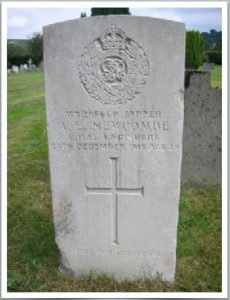
Arthur Edward Newcombe was born at Charlton Kings, Cheltenham in the third quarter of 1889 and was the son of Edward and Mary Jane Newcombe of Pike House, Battledown, Greenway, Charlton Kings.
According to the 1911 Census the couple had nine children, seven of which had survived. Prior to the war he had been employed as an Assurance Agent and also by the Gloucestershire Dairy, enlisting in the Royal Engineers on the outbreak of war (and was given the number 68531).
According to his Medal Index Card he served at Gallipoli after being sent overseas for his first post on 5th September 1915.
He was part of the evacuation at Suvla Bay in December of that year. He then transferred to the Salonika front in northern Greece, where he remained for the duration of the war with the 117th Railway Operating Company.
The Salonica campaign was under the command of the French Army and involved contingents from Britain, France, Italy, Serbia, Russia, Albania and in the latter stages, Greece. The British contingents were, from 1915 to the end of hostilities, situated in the unhealthiest part of the front, plagued by mosquitoes and suffering insanitary conditions, both of which were responsible for much illness and death.
At the end of the war, Arthur returned to England with severer malarial fever and was immediately admitted to Priory Voluntary Aid Detachment Hospital in Cheltenham where he died on 24 December 1918, aged 29.
He left a widow, Annie Newcombe (née Cooper) whom he had married, in Cheltenham, in the spring of 1914. She lived at 8 Mapledene Terrace, Fairfield Avenue, Cheltenham.
His brother, Leslie, served with the Canadian Army in the war and died in Belgium from bronchia-pneumonia on 7 March 1919.
Arthur Newcombe is buried in Cheltenham Cemetery, his grave marked with a CWGC headstone and he is commemorated on the Charlton Kings’ War Memorial.
There are photographs of him in The Graphic of 22 June 1918 and 11 January 1919.
Researched by Graham Adams 3 February 2013 with aAcknowledgement to ‘Leaving All that was Dear – Cheltenham and the Great War’ by Joe Devereux and Graham Sacker)