
3/6th Battalion, Gloucestershire Regiment
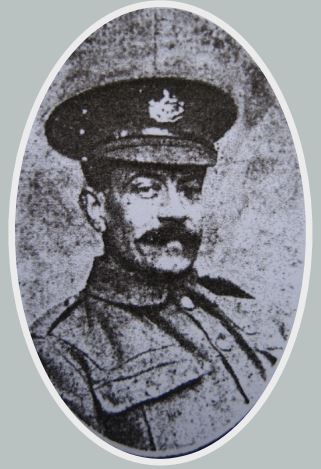
Harry St Clair Clifford Webb was born in Charlton Kings in 1879 and was a painter by trade; prior to the war he had been employed by Messrs C H Rainger of 9/10 Bath Place, Cheltenham. In 1900 he had married Winifred Helen Furley at Cheltenham and the couple had two children, prior to the start of the Great War.
Unusually some papers from Harry’s Service and Pension Records have survived and these enable a few details of his military career to be pieced together. He joined the Territorial Army on 20 May 1913, signing on for four years service and was posted to 1/5th Battalion of the Gloucestershire Regiment (with the number 1883). At the time of enlistment he gave his address as 2 St George’s Place, Cheltenham. Upon the outbreak of war he was immediately embodied into the 1/5th Glosters and became a Band Sergeant on 20 June 1915 and Sergeant Drummer on 20 September 1915, a post held until the following November. He then appears to have been posted to a reserve unit (83rd Battalion?), where he spent his time until his discharge on 7 August 1916.
His discharge came as a result of a medical board held on 24 July 1916. He had had cardiac related problems dating back to time under canvas on the Isle of Wight in August 1914 and it was now considered that these were sufficiently great to render him unfit for military service and he was awarded a pension and the Silver War Badge (SWB) record shows him being in receipt of a badge, following discharge, due to sickness, on 7 August 1916. As a Territorial, Harry had not be obliged to serve overseas, without his express consent. He had given his written consent on 12 June 1916 but the SWB record confirms there had been no overseas service.
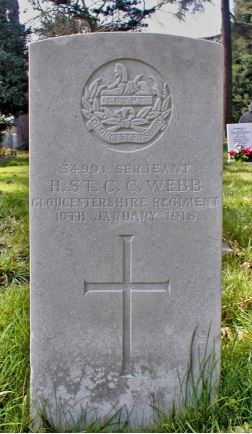
Having been discharged and placed on the pension roll in August 1916, there is something of a mystery as to what happened to Harry between that date and his death in January 1918. In their book Leaving All that was Dear – Cheltenham and the Great War, Joe Devereux and Graham Sacker note that Harry was eventually drafted into the 3/6th battalion, Gloucestershire Regiment and died of heart disease whilst at camp in Northumberland. The CWGC Register notes his Army number as 34991 (which is on his headstone). This number does not appear in any of the above Service or Pension papers (and there is no Medal Rolls Index Card). According to the Pension papers medical board reviews were conducted in January and December 1917 and the continuance of pension payments confirmed. The medical review conducted on 20 December 1917 notes that Harry’s address to be Seaton Delaval, Northumberland. Brigadier E A James’, British Regiments 1914-1918 notes that the 3/4th, 3/5th and 3/6th Battalion of the Glosters were amalgamated into the 4th Battalion on 1 September 1916 and in October 1917 it was deployed at Seaton Delaval, Northumberland, as the Tyne Garrison.
According to the Register of Deaths, Harry Webb died in the Tynemouth District of Northumberland on 10 January 1918, aged 39. So, somehow, notwithstanding his discharge from the Army, the issuance of a Silver War Badge to mark his invalidity due to military service and his continuing receipt of a pension, Harry appears to have ended up back in military service. A recently released Pension Record Card records that the cause of death was ‘syncope mitral stenosis (heart condition) (combined with) rheumatic fever’.
Harry Webb was buried in Cheltenham Cemetery on 16 January 1918 and a CWGC headstone now marks his grave. He is commemorated on the Cheltenham Borough War Memorial. His photograph appears in The Graphic of 19 January 1918.
He left behind his wife Winnie and two children, a daughter born in 1901 and a son in 1916. There is a further, sad, twist to his story. Winnie gave birth to a third child, shortly after her husband died and she gave the baby her husband’s Christian names. However, it would appear that the baby died shortly after birth, as the Register of Death’s records him as having died in early 1918, without attaining the age of one. The entry above is that of his father.
Researched by Graham Adams 12 February 2013 (revised 10 August 2021)