1/14th Battalion, London Regiment (London Scottish)
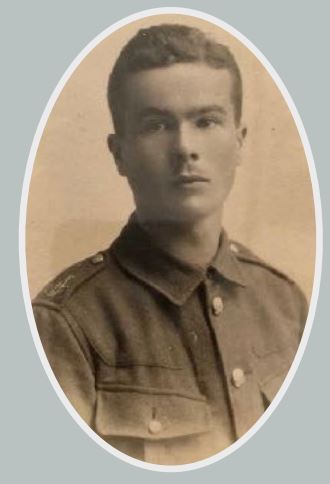
William Harkness Evans was born at Bradley, near Ashbourne, Derbyshire on 20 April 1897. He was the son of Albert Bevan Evans (1871-1951) and his wife Julia Augusta (née Wilson: 1871-1964). He had one brother, Leslie Edward Wilson Evans (1898-1982).
At the time of the 1911 Census the family lived at The Verlands, Upton Lane, Gloucester. Albert Evans was the Headmaster at Barnwood School.
There are three important sources of information about William’s pre-war life and Army service. An Army Service Record survived the German bombing raid in 1940, when the majority of records were destroyed. He has an entry in De Ruvigny’s Roll of Honour (DRRH) and a report of his death appeared in the Gloucester Journal of 18 January 1919. Taken together these enable us to have quite a detailed picture of William’s life.
He appears to have been a bright lad. At ten years of age he headed the scholarship list for Gloucester and was educated at Sir Thomas Rich’s School. He left at the age of fifteen and joined the staff of Barclays Bank and was posted to their Walthamstow Branch in east London and lived in lodgings at 9 Field Avenue. He became a member of the Institute of Bankers and passed their qualification examinations.
He attested for military service under ‘Lord Derby’s Scheme’ on 3 December 1918 at the age of 18 years and seven months, however he was not mobilised until 29 April 1916, when aged 19, the age at which it was permitted to post him abroad. His posting was to the 1/14th Battalion of the London Regiment, better known as the ‘London Scottish’. This was a well respected Territorial Force (TF) unit: prior to the war entrants were required to pay a joining fee. He was allocated the number 7669 and in 1917 this was changed to 513580, when all serving TF force personnel received a new six digit number.
William spent the summer months in training and was posted to the British Expeditionary Force (BEF) on the Western Front on 7 September 1916. The London Scottish had been in action since the early days of the war and were part of 168 Brigade, 56th (London) Division. No doubt, in common with all new arrivals into the BEF, William spent a week or so training for trench warfare before joining the London Scottish in the field. In the middle of September 1916, they were located in the Somme sector, near to Angle Wood, south south east of the village of Guillemont. Shortly after 56th Division was involved in the fighting around Bouleaux and Leuze Woods, west of Combles and on 25 September it advanced to within 500 yards of that village.
The Gloucester Journal states that William was wounded in the head (over the right eye) and in the right knee at Neuve Eglise on 31 October 1916 and was admitted to hospital. The Battalion War Diary shows that this time the Battalion was located at Fauquissart, a village between Laventie and Neuve Chapelle and almost certainly ‘Chapelle’ should be substituted for ‘Eglise’.
DRRH also states that at about this time William was offered an officer’s commission, which he declined. If this is true, then it does seem odd that he never rose above the rank of Private.
He had recovered from his wounds by 9 April 1917, the opening day of the Battle of Arras and according to DRRH William saw action, when 56th Division attacked the Hindenburg Line south east of Arras, where the village of Neuville Vitasse was the main feature.
Later that year the London Scottish was located in the Ypres Salient. According to its War Diary, on 16th August the Battalion was located near Zillebeke and eleven Other Ranks were killed and ten wounded in a battalion carrying party. DRRH says that on 17 August William suffered fourteen wounds to the head, both legs and arms. The Gloucester Journal report states that a heavy shell fell on a party of men, killing a number and burying William. The latter date is probably when the casualty report was submitted.
William was dug out and it was discovered that a piece of shrapnel had penetrated his skull, besides other wounds to his head, arms and legs. His wounding was officially recorded in the War Office’s Weekly Casualty List of 19 September 1917. He was taken to a hospital in Rouen, where he remained in a critical condition for sometime and his father was summoned to his bedside. His condition improved such that he could be safely returned to England on 7 October 1917, initially to a hospital in Lancashire and latterly to the Red Cross Hospital in Gloucester.
The Gloucester Journal’s report states that he was ‘discharged’ on 20 December 1918. This was the date he officially left the Army, as no longer fit for service and may or may not have coincided with his discharge from hospital. Evidently, he remained in a poor condition and gradually deteriorated. He collapsed on 10 January 1919 and was rushed to the Red Cross Hospital for an emergency operation, following which he died the following day, aged 21.
His funeral took place at Barnwood Parish Church on 15 January and he was buried in the churchyard, where a standard CWGC headstone marks his grave.
His entry in DRRH reports that his Serjeant wrote of him: He was a true man both in and out of the line – one whom I always selected for the most trying work. His comrades loved him, while I relied upon him. It will be difficult to find his equal.
William’s younger brother, Leslie, served as a Lance Corporal in the 2nd Battalion, Honourable Artillery Company. He served on the Western Front and from September 1917 in Italy, where he was badly wounded. The War Office Weekly Casualty List reported this on 13 August 1918. For several months he and his elder brother had adjoining beds in the Red Cross Hospital at Gloucester.

Researched by Graham Adams 19 March 2020