
Grenadier Guards
Thomas Spiers was born at Dumbleton, north Gloucestershire on 10 July 1880, the son of Sarah Spiers, a cook and domestic servant who was aged 19 at the time and apparently unmarried. She married Charles Sallis on 1 February 1883 and in the 1891 Census he is shown as being Charles Sallis’ stepson. On his Royal Marines Attestation form, Charles Sallis is down as next of kin.
Having been a labourer, Thomas’ first experience of the military was with the Royal Marine Artillery (RMA), where (after enlisting at Birmingham) he served as a Private (number 8451), with No 2 RMA Supply, from 14 October 1899 until 17 January 1900, when he purchased his discharge for the sum of £10.
Thomas became a house painter before enlisting in the Army at Cheltenham on 18 September 1902 and joining the Grenadier Guards. He initially signed on for a twelve year term, and three years with the colours followed by nine years in the Reserve. This would mean that he was committed to the Army until 18 September 1914, with the proviso that should the country be at war a maximum of a further years’ service would be added. This proved to be the case.
He elected to extend his service with the colours by a further six years on 3 February 1904 and he was promoted to Corporal on 11 August 1906. After serving for eight years with the colours he finally entered the Reserve on 18 September 1910.
As his commitment to the Reserve had not expired by the time war was declared in August 1914 Thomas was mobilised on the 5th of that month. His Service Record has not survived but some papers relating to his pension have and indications are that he was posted to 7 Company, Army Cyclist Corps, part of 7th Division’s Divisional Mounted Troops. He sailed from Southampton for Belgium on 4 October, probably for Zeebrugge, as the Division was assigned to the defence of Antwerp. However, the port had been lost, more or less, by the time it arrived and arriving troops were assigned to covering the retreat of the Belgian Army. On 28 October he was promoted to Lance Serjeant and received a slight gunshot wound on 3 November 1914. After hospital treatment he was sent back to the UK on 15 November and posted, on 25 November, to 4th Battalion, Grenadier Guards, a reserve battalion based at Chelsea Barracks. He remained in the UK for the rest of his service. On 1 April 1915 he was promoted to (Acting) Serjeant and on 17 September 1915, after 13 years, his Period of Engagement had finally ended and he was discharged and received an Army Pension.
What happened to him, post Army service is not known – possibly he returned to his original occupation as a house painter. His Pension File does give a possible hint of a serious medical condition, as it would appear that he spent the period 26 June to 27 July 1916 in hospital with diabetes. Maybe this was the underlying cause of death on 21 October 1916, aged 36.
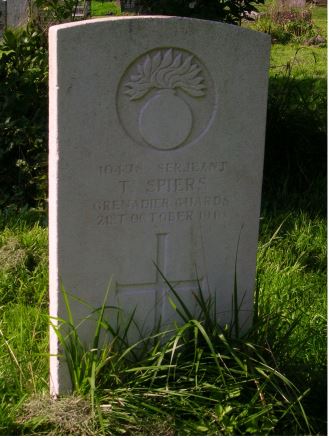
He was buried in the churchyard of Dumbleton (St Peter’s) Church on 24 October 1916 and a standard CWGC headstone marks his grave. Oddly, his name is not present on the village War Memorial or inscribed tablet inside St Peter’s Church – possibly as he was not viewed as a ‘war casualty’ at the time.
Researched by Graham Adams 15 January 2017