2nd Battalion, Gloucestershire Regiment
Researching Private William Ford’s service in the Great War has been hampered by the fact that very few records have survived and the normally informative Army Service and Pension records appear to have been lost: no doubt the Service Record was one of those destroyed in a bombing raid on London in 1940. However, from the scraps of information available, some assumptions can be drawn.
William Ford was born on 26 December 1885 in Gloucester. His parents were Charles Henry Ford (1852-1909) and his wife Harriet (née Drinkwater: 1852-1918). He is believed to have had eight siblings: Betsy (born and died 1872); James (born and died 1876); Emma (1878); Gertrude (1881); Charles (1883); Henry (1888); John (1891) and Annie (1895). At the time of the 1901 Census the bulk of the family was living at 136, Millbrook Street, Gloucester.
It is highly likely, given his Army number (7670) and his battalion in the Gloucestershire Regiment and his early departure for France, that William was a pre-Great War professional soldier. His number indicates that he probably enlisted sometime between March 1904 and November 1905, when he would have been aged 19. He probably enlisted for a period of twelve years, maybe eight ‘with the Colours’ (ie actively serving) and the remaining four with the Reserve. He very likely served with the 1st Battalion of the Gloucestershire Regiment and no doubt saw service in India – however none of this can be corroborated.
Having undertaken his initial period of service he probably returned to civilian life in about 1913 and married Annie Florence Bullock (1888-1929) in Gloucester on 25 April 1914. The couple lived at 62 Millbrook Street, Gloucester and had one child, Arthur William John, in 1915. At the time of his marriage William worked as a labourer.
As a Reservist he was no doubt recalled to the Army when war broke out in August 1914. His Medal Index Card states that he served with the 1st Battalion of the Glosters (part of 3rd Brigade, 1st Division) and first went to the Western Front on 27 August 1914. This was about a fortnight after the bulk of the battalion had crossed the Channel. The Glosters were involved in the ‘Retreat from Mons’. He would appear to have, at some point, transferred to the 2nd Battalion of the Glosters and served in Salonika. At the end of November 1915 the 2nd Glosters sailed for Salonika, arriving on 12 December 1915, part of 81st Brigade, 27 Division. On 3 November 1916 the battalion transferred to 82nd Brigade (same Division) and was to serve in that area of the Balkans until the end of the war. The Salonika Front, where the British and French were fighting the Bulgarians, was a notoriously unhealthy place in which to fight and malarial infection was rife. Possibly this caused William’s repatriation at some point?
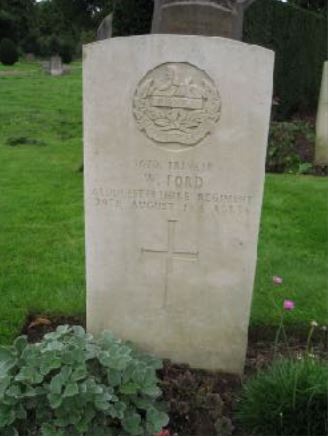
According to the Gloucestershire Regiment volume of Soldiers Died in the Great War William died in Salonika but, conforming with the then Imperial War Graves Commission policy, he would have been buried in that location. The Register of Soldiers’ Effects held at the National Army Museum states that he died at the 2nd Southern General Hospital, Bristol, however, it is believed that the death notice posted in the Cheltenham Chronicle of 7 September 1918 is more accurate. This states that death occurred on 29 August 1918 at the Red Cross Hospital in Gloucester. He was 33 years of age and the exact cause of death is unknown but it would appear that William was still a serving soldier. He was buried in Gloucester Old Cemetery, where a standard CWGC headstone marks his grave.
His widow re-married, to William Joseph Green, in Gloucester on 18 July 1920.
Researched by Graham Adams 27 November 2019