
Royal Engineers (Staff)
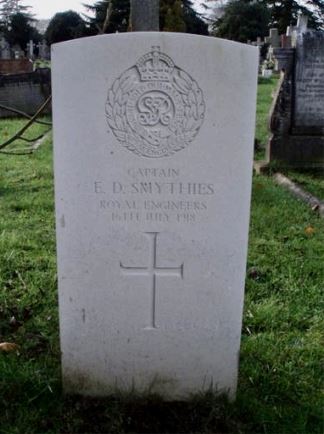
Ernest Dudley Smythies was born on 29 April 1887 in Rosario, Argentina, where his parents had emigrated to become ranchers. He was the son of Frederick Kynnersly and Frances Harriott (née Egremont). He had two brothers (Wilfred March (born1876) and Reginald Eric (born 1888) and a sister Margarita Hilda (born 1890). Wilfred may well have been a seafarer as records indicate he died off the Gold Coast in 1896.
Ernest was educated at St Anne’s School (possibly in Bath) and around 1903 was at HMS Conway, a naval training establishment at Birkenhead. In 1910 he was serving as a Merchant Navy Officer with the Honourable East India Company Ships and gained an Extra Master’s Certificate on 22 September 1913.
He was married to Elizabeth H Smythies but where and when the marriage took place is unknown.
Perhaps surprisingly, given his seafaring background, Ernest attested to join the Army on 7 June 1915, initially to serve four years with the Territorial Force in the UK. He gave his address as St Helen’s, Road Hill, near Bath. His first posting was as a Private into the Inns of Court Officer Training Corps and this was quickly followed by promotion to Serjeant in September 1915. On 25 September 1915 he was commissioned as a Second Lieutenant and posted to the 17th (Service) Battalion of the King’s Royal Rifle Corps, who were part of 117 Brigade, 39 Division. After training at Hursley Park, Witley and Aldershot the battalion went to France to join the British Expeditionary Force (BEF) on 8 March 1916.
On 22 May 1916, whilst in action at Givenchy, Second Lieutenant Smythies was seriously wounded. The circumstances were described when his name was put forward for consideration for the Croix de Guerre in 1918:- Whilst serving as a bombing officer in the King’s Royal Rifle Corps at Givenchy (on the La Basse Canal) on 22 May 1916 and engaged in a local hand grenade and artillery bombardment, a small high explosive shell dropped into the communication trench a few feet in front of this officer and he received several wounds, his left leg being half severed through the knee. He was also rather severely wounded in the left arm and in several places in the left leg, with minor injuries to the right eye, nose and back. In consequence of gas gangrene setting in, his leg had to be amputated the following day, the operation being performed at the CCS Bethune … At the time he was wounded Captain Smythies was a Second Lieutenant.
Ernest was repatriated to the 4th London General Hospital, Denmark Hill, London and spent about a year in various hospitals and convalescent homes and undergoing further minor operations. He was fitted with an artificial leg.
He remained in the Army and on 30 May 1917 was transferred to the Inland Waterways & Transport Section of the Royal Engineers, following a medical board at Blackpool. He stated that he had qualifications useful in that Section and he took up his post as a Staff Captain, Deputy Marine Superintendent, at the War Office in London.
In 1918 the War Office was informed that the French Government has placed two Croix de Guerre at their disposal, to be awarded to current serving staff officers who had lost an eye, or limb or had been severely wounded. Smythies name was put forward as the only officer in the Directorate to qualify. It is not known where the medal was ever awarded or presented.
On 12 July 1918 Captain Smythies was admitted to Queen Alexandra’s Military Hospital, Millbank, London with influenza and died of pneumonia at 4pm four days later on the 16th. He was aged 31.
For reasons which are unknown he was buried in Cheltenham Cemetery, his funeral, with military honours, on 20 July 1918, being reported in the Gloucestershire Echo of that date. One of the mourners was his uncle, Commander Edward Powell Smythies RN, of Springfield Lawn, Cheltenham, who was a prominent member of social and charitable circles in the town. Ernest’s widow, brother Eric, and commander Smythies wife were also present; Major Steward and officer colleagues from the War Office acted as pall bearers. A standard CWGC headstone now marks his grave.
Researched by Graham Adams 23 February 2016